This last weekend I decided it was time to finish a remodeling job that I started 2 years ago. You know, the last part of a project that isn’t that important, just cosmetic, a hassle. I never had the time to get into it. This job required me to do some wood working and getting into work positions low to the ground (squatting and kneeling). These are not positions that I spend much of my normal work day doing. Needless to say come Monday my hamstrings and quads were feeling pretty tight and sore.
Usually, over the summer I lower my running mileage and work more on my functional strength. That didn’t happen this year. I really dropped off on my functional strengthening as I just never seemed to have the time to get it done. It was a hassle. We runners with healthy joints must keep our ability to squat and lunge (functional strength and mobility). As I approach the age of 45 this is becoming more and more obvious to me. Because my home improvement projects are becoming less frequent, I could lose this ability if I don’t continue to work on it. My running could eventually suffer. So my home improvement project served as a gentle reminder to get back to my functional strength program. GET IT DONE & DON’T PUT IT OFF!
Thursday, September 25, 2008


Monday, September 22, 2008
Friday, September 19, 2008
Hood to Coast
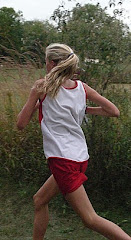
Two of John's legs during the Hood to Coast 2008! The team was 1st in master's division! Nice job John and the rest of his team in the "Mother of All Relays"
Tuesday, September 16, 2008
The Gluteus Medius


The gluteus medius muscle. Maybe one of most important muscles for running. Weakness in this muscle can lead to many injuries such as IT Band syndrome, knee pain, hip pain, and even back pain. Functional strength and endurance of this muscle is crucial to any athlete that spends much of the time running. The muscle is hidden underneath the big gluteus maximus (buttock muscle) and the fascia/fibers of the ITBand and Tensor Fascia Lata. This muscle is the muscle that keeps your hip stable while your foot is flat on the ground whether you are running or just standing on one leg. A weak glute med will allow your hip to drop too much leading to changes in your mechanics all the way down to your foot and up through your spine. A person might have a strong glute med muscle during muscle testing or even standing on one foot for 30 seconds, but the question is whether that muscle has the endurance to last for miles. And can that muscle perform the same when positions are changed such as when kicking a soccer ball or moving laterally to make a tackle? Both males and females are at risk for this weakness, however, the biomechanics of a female pelvis make them much more suceptible (wider pelvis) to weakness. A good video analysis of running can identify weakness as well as specific functional tests. In future posts we will have pics and videos to demonstrate these self-tests and strength training for this important muscle.
Monday, September 15, 2008
The Foam Roller Revisited

The foam roller is an excellent, inexpensive piece of workout equipment that can be used to mobilize tight muscles, increase flexibility, and prevent injury. It can also be used for a number of core strength exercises. There is a great link to the Perform Better website that outlines a number of exercises that can be performed on the foam roller: http://www.performbetter.com/catalog/assets/Exercisesheets/PDF/FoamRoller.pdf
The number one injury that we use the foam roller for is Ilio-tibial Band Syndrome (ITB Syndrome). We see many runners and athletes that have lateral knee pain or hip pain that is due to or at least in part by an IT Band that is full of adhesions and trigger points. Usually, these restrictions are the result of some other impairment or muscle imbalance (weak gluteals or hip stabilizers, shoes, leg length discrepancies, cycling mechanics, etc.)
During rehabilitation, we have patients perform ITBand release techniques daily. We start out with 1-2 minutes of rolling and progress to 5-10 minutes. The first few times usually are not very comfortable especially if a person has multiple trigger points or "hot" spots. We will instruct clients to roll until you "feel" a hot spot and hold at that point for 15-20 seconds and then continue rolling.
We recommend after rehabilitation is complete performing foam roller muscle release exercises 1-2 times or more (depending on the person) per week to keep tissues and muscles flexible.
In the future, we will post video of several myofascial release techniques using the foam roller.


Thursday, September 4, 2008
Cool places to run...Indy

Today at the Runner's Lounge, we are to share our favorite places to run. My hometown of Indianapolis has several cool places to run. Downtown try hitting the IndyCanal loop. A little further north of downtown run on the Central Canal Towpath. The best place to start is in the village of Broad Ripple. From here you can either run on the gravel/ dirt canal path or hit the paved Monon Trail. My favorite place to run is Eagle Creek Park. The trails are especially beautiful in the fall. Check out these links and our sidebar for other cool places to run.
Friday, August 29, 2008
A proper hip flexor stretch
 Hip Flexor Stretch: Kneel onto one knee. Perform a gentle pelvic tilt by contracting your abdominal muscles. This motion is similar to "rolling the belt buckle toward the nose." When the pelvic tilt is performed, a slight stretch should be felt down the front of the thigh. If no stretch is felt with the pelvic tilt, then leaning forward slightly is allowed but the pelvic tilt must be maintained and the back should be straight. If no stretch is felt in this position then it is not necessary to stretch this muscle group. Again it is important that the stretch should be light to moderate in intensity. 3 times each leg, holding 20 seconds.
Hamstring stretch

Hamstring stretch: Lie on back holding behind one knee with hands as shown. Begin to straighten the knee slowly until a gentle stretch is felt in the hamstring. Hold twenty seconds then let the knee bend. Repeat 3 times.
Pictures from mckinley.uiuc.edu.
This is a safe hamstring stretch as it protects the lower back and provides a stretch over the entire hamstring belly. However, it is important to be aware of each person's limitations and to recognize that not everyone will be able to straighten the leg all the way. It is very important to stretch only into light to moderate stretch, NOT a heavy stretch.
Wednesday, August 27, 2008
Run. Rest and recover. Repeat
I have an extreme example of this week's topic on Take it and run Thursday.
This last weekend, I finished my first Hood to Coast Relay. This was a true test of physical and mental endurance especially because I only had about 4 weeks of quality training. HTC is a 12 person relay from Mt. Hood 197 miles finishing on the beach at Seaside Oregon. It is an extreme example of run, rest, recover and repeat all within 24 hours. Each runner runs 3 legs staying in order. For example, runner 1 hands off to runner 2, who then hands off to runner 3 etc.. until the order begins again. The runner is then picked up by their team van while the other van transports the next runner up to the next exchange point. I was runner 10 who ran legs 10, 22 and 34 of 36 legs. The race began early Friday and started in waves of teams with similar projected finishing times. Our team started at 6:45 PM. I took the hand off at 12:03 am Saturday and ran in the dark on a rolling paved trail for 6.88 miles. I tried to hold my goal pace despite the feeling that I had to cut my stride as I was having a difficult time seeing the trail. Upon finishing this leg, I was very hungry and felt depleted. I would now have about 6 hours to rest, recover and race again! I decided to try a new energy replacement drink, chocolate milk. In this case it was organic soy chocolate milk. After chugging this I felt 100% better. I then ate some bagels and peanut butter. Later I drank water with a Nuun tablet. The resting part of this phase was difficult as I found it impossible to sleep in a van with 7 people. We were unable to take advantage of the designated sleeping areas as our very experienced team captain felt it was important to keep the vans traveling together from each exchange point. However, this would have allowed me to get 1-3 hours of important shut eye. Many will argue that sleep is not necessary in a racing scenario but for me I believe it would have helped me in the 3rd leg.

My second leg began at daybreak around 7am. This leg (22) started with a 1.5 mile uphill climb and the a long 5 mile downhill along a beautiful tree lined Oregon road and a creek. I ran fairly consistent despite now being awake for over 24 hours and having to be careful to avoid Hamstring and Quad spasms from the hills. I again drank the soy chocolate milk and almost instantaneously felt better.

In the final legs, the exchange points began to get congested as we were catching the slower teams. This made it difficult to stay loose as we had to get our next runner up the road before our current runner passed us. I had the most trouble on leg 3 as most of this 4.10 (34) was in direct sun and it was hot! I wasn't in road kill mode, but I did back off my goal pace. I was on the edge of a hamstring spasm again and I was in need of water. When I finished my legs and I were happy to be near the end of this journey through Oregon. Our team hit the beach 19th overall and 1st in our division, just about 2 minutes off our projected finish!
This truly is the mother of all relays and is an extreme example of run, rest, recover and repeat!
Now it is time for me to really get some REST! Good job everybody and thank you.

This last weekend, I finished my first Hood to Coast Relay. This was a true test of physical and mental endurance especially because I only had about 4 weeks of quality training. HTC is a 12 person relay from Mt. Hood 197 miles finishing on the beach at Seaside Oregon. It is an extreme example of run, rest, recover and repeat all within 24 hours. Each runner runs 3 legs staying in order. For example, runner 1 hands off to runner 2, who then hands off to runner 3 etc.. until the order begins again. The runner is then picked up by their team van while the other van transports the next runner up to the next exchange point. I was runner 10 who ran legs 10, 22 and 34 of 36 legs. The race began early Friday and started in waves of teams with similar projected finishing times. Our team started at 6:45 PM. I took the hand off at 12:03 am Saturday and ran in the dark on a rolling paved trail for 6.88 miles. I tried to hold my goal pace despite the feeling that I had to cut my stride as I was having a difficult time seeing the trail. Upon finishing this leg, I was very hungry and felt depleted. I would now have about 6 hours to rest, recover and race again! I decided to try a new energy replacement drink, chocolate milk. In this case it was organic soy chocolate milk. After chugging this I felt 100% better. I then ate some bagels and peanut butter. Later I drank water with a Nuun tablet. The resting part of this phase was difficult as I found it impossible to sleep in a van with 7 people. We were unable to take advantage of the designated sleeping areas as our very experienced team captain felt it was important to keep the vans traveling together from each exchange point. However, this would have allowed me to get 1-3 hours of important shut eye. Many will argue that sleep is not necessary in a racing scenario but for me I believe it would have helped me in the 3rd leg.

My second leg began at daybreak around 7am. This leg (22) started with a 1.5 mile uphill climb and the a long 5 mile downhill along a beautiful tree lined Oregon road and a creek. I ran fairly consistent despite now being awake for over 24 hours and having to be careful to avoid Hamstring and Quad spasms from the hills. I again drank the soy chocolate milk and almost instantaneously felt better.

In the final legs, the exchange points began to get congested as we were catching the slower teams. This made it difficult to stay loose as we had to get our next runner up the road before our current runner passed us. I had the most trouble on leg 3 as most of this 4.10 (34) was in direct sun and it was hot! I wasn't in road kill mode, but I did back off my goal pace. I was on the edge of a hamstring spasm again and I was in need of water. When I finished my legs and I were happy to be near the end of this journey through Oregon. Our team hit the beach 19th overall and 1st in our division, just about 2 minutes off our projected finish!
This truly is the mother of all relays and is an extreme example of run, rest, recover and repeat!
Now it is time for me to really get some REST! Good job everybody and thank you.

Sunday, August 17, 2008
the mother of all relays...

Next Friday, I'll be starting my first Hood to Coast. This is going to be interesting. I agreed to do this about 4 weeks ago after I had lowered my mileage for my summer vacation from long runs. I then didn't follow my own advise and really entered into a rushed training program. I don't usually do much hill training but I felt that I had better start. Training has gone well but I have had slight right Quad tendon pain after the hills. Last Monday I was assigned to be runner 2 (3rd hardest). At first I thought this would be awesome as I get to run down Mt. Hood. I knew runner 1 had the hardest downhill and I was grateful that wasn't going to be me. But then I looked up runner 2's first leg. Runner 2 gets the pleasure of a 5.67 mile 5% downhill run with no level ground to break it up. Panic began to creep into my mind as I could almost feel my knee saying, " Don't do it stupid, not on the very first leg." I realized that if I ran this downhill leg first, I would likely have problems finishing the race, which would let my team down. Having always volunteered to hard legs (6&8) at River to River, it was hard for me to make the calls to look for someone who would be willing to switch legs. I got lucky when one of my friends from college, who is on the team agreed to give me runner 10 (4th hardest) instead. Runner 10's legs are no picnic. The hardest leg of runner 10 is the second one. It begins with a 1.5 mile 4.7% uphill climb and then drops downhill for 5 + miles. This downhill on paper, looks better as it levels off at times. At least this isn't the first leg. I feel that I have a better chance of not dropping off race pace as runner's 10 last leg is short and more level. As I said, this will be an interesting adventure!

Thursday, August 14, 2008
Simple injury prevention--Tip 5
Today on Take and run Thursday the topic is taking care of your feet. I find myself repeating these tips frequently during my work week so I thought I would share them with the Lounge.
1. Avoid wearing poor shoes... high heels, flip flops, or any other shoes which are uncomfortable. I know this is easier said than done, but at least avoid wearing them for long periods of time especially when standing or walking.
2. Don't continue to run in worn running shoes too long. I usually advise my patients to purchase a new shoe when the out sole of the current shoe begins to wear down or if approaching 300 miles. Get a second pair and start using them for the longer or harder runs.
3. Be careful buying a super soft cushioned shoe especially if a foot tends to over pronate. If a new shoe feels really soft and cloud like, there is a good chance it is too soft. Don't ju st buy the same shoe again. Make sure there haven't been any major changes to that model. Video taping running in the shoes and studying the way a foot reacts to that shoe is the best way to find the proper shoe. Compare the old shoes to the new shoes.
4. Avoid sitting on the foot when sitting! This is a very common mistake which will not only over stretch the soft tissue of the ankle but will likely cause knee, hip and back issues as well.
5. At the end of the day or run, if the feet are sore ice and take a day off. The sooner the soreness is addressed, the quicker they will heal. Too many times I hear patients that have had plantar fasciitis for over a year say, "but it didn't really hurt that bad".
I hope this is helpful.
In one week I leave for my first Hood To Coast and will be sporting a Runner's Lounge T Shirt.
1. Avoid wearing poor shoes... high heels, flip flops, or any other shoes which are uncomfortable. I know this is easier said than done, but at least avoid wearing them for long periods of time especially when standing or walking.
2. Don't continue to run in worn running shoes too long. I usually advise my patients to purchase a new shoe when the out sole of the current shoe begins to wear down or if approaching 300 miles. Get a second pair and start using them for the longer or harder runs.
3. Be careful buying a super soft cushioned shoe especially if a foot tends to over pronate. If a new shoe feels really soft and cloud like, there is a good chance it is too soft. Don't ju
 st buy the same shoe again. Make sure there haven't been any major changes to that model. Video taping running in the shoes and studying the way a foot reacts to that shoe is the best way to find the proper shoe. Compare the old shoes to the new shoes.
4. Avoid sitting on the foot when sitting! This is a very common mistake which will not only over stretch the soft tissue of the ankle but will likely cause knee, hip and back issues as well.
5. At the end of the day or run, if the feet are sore ice and take a day off. The sooner the soreness is addressed, the quicker they will heal. Too many times I hear patients that have had plantar fasciitis for over a year say, "but it didn't really hurt that bad".
I hope this is helpful.
In one week I leave for my first Hood To Coast and will be sporting a Runner's Lounge T Shirt.
Thursday, July 31, 2008
Functional Strengthening
Functional Strengthening/Mobility
I decided that it would be beneficial to provide an occasional link to our previous posts/ video regarding functional strengthening and mobility exercises.
the why...
Got Strength?You don't have squat?Be Hip
the video...
Squat Lunge Step downs Step overs
more to follow...
Note to readers: Always consult a physician before starting any exercise program.
The posts on this blog are purely for educational purposes only. The information written in the posts is the opinion of the authors and should not be taken as medical advice.
I decided that it would be beneficial to provide an occasional link to our previous posts/ video regarding functional strengthening and mobility exercises.
the why...
Got Strength?You don't have squat?Be Hip
the video...
Squat Lunge Step downs Step overs
more to follow...
Note to readers: Always consult a physician before starting any exercise program.
The posts on this blog are purely for educational purposes only. The information written in the posts is the opinion of the authors and should not be taken as medical advice.
Subscribe to:
Posts (Atom)
 Stumble It!